

The Eastern Mole, which may have raised some ridges on your lawn, is a predator. With its long snout and upward-tilted nostrils, it uses stereoscopic sniffing to find earthworms in the darkness of its underground tunnels.
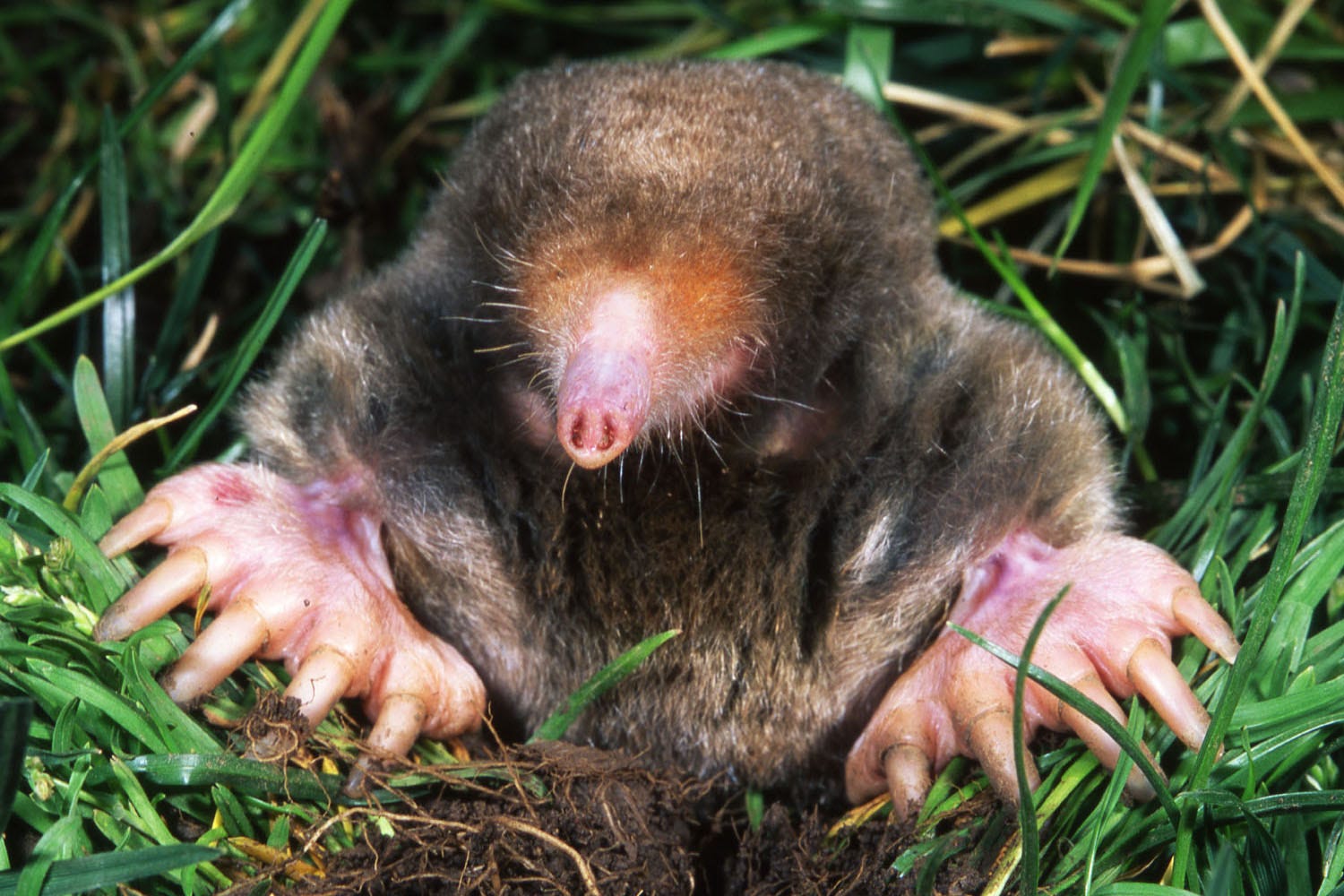
You and I have stereo hearing. Our brains compare the signals reaching our two ears to discern the direction. Maybe that’s something like what stereo sniffing feels like to an Eastern Mole, as it compares what each nostril smells.
Big home of a small mole
Digging its way through the ground, a mole moves as naturally as a fish swims through water. Its front paws, which are much larger than the back paws, have long, powerful claws, webbed fingers, and outward-facing palms. The front paws separate the soil like a human swimmer doing the outward sweep of an underwater breaststroke.
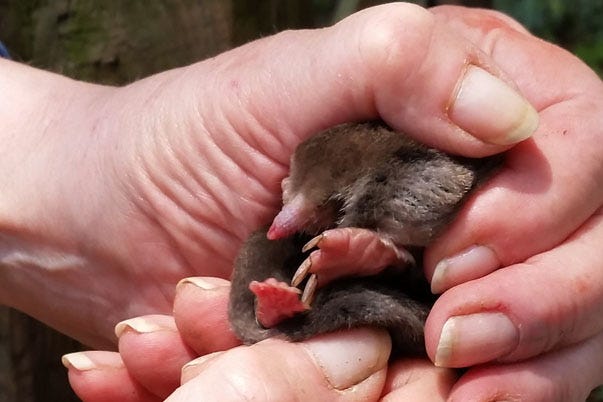
The Eastern Mole is a small animal. Sleek fur helps it slide through the tunnels. Those who have handled a mole say it has the softest fur they’ve ever touched.
Eyes wide shut
The mole’s eyes are the size of poppy seeds, each covered with a translucent, permanently-sealed membrane. The mole senses light and dark — but it can’t see images.
Since the mole lives underground and seldom comes out in the open, big eyes would not help much and would always be getting dirt in them. Smell is the mole’s way of seeing.
Earthworks of the mole
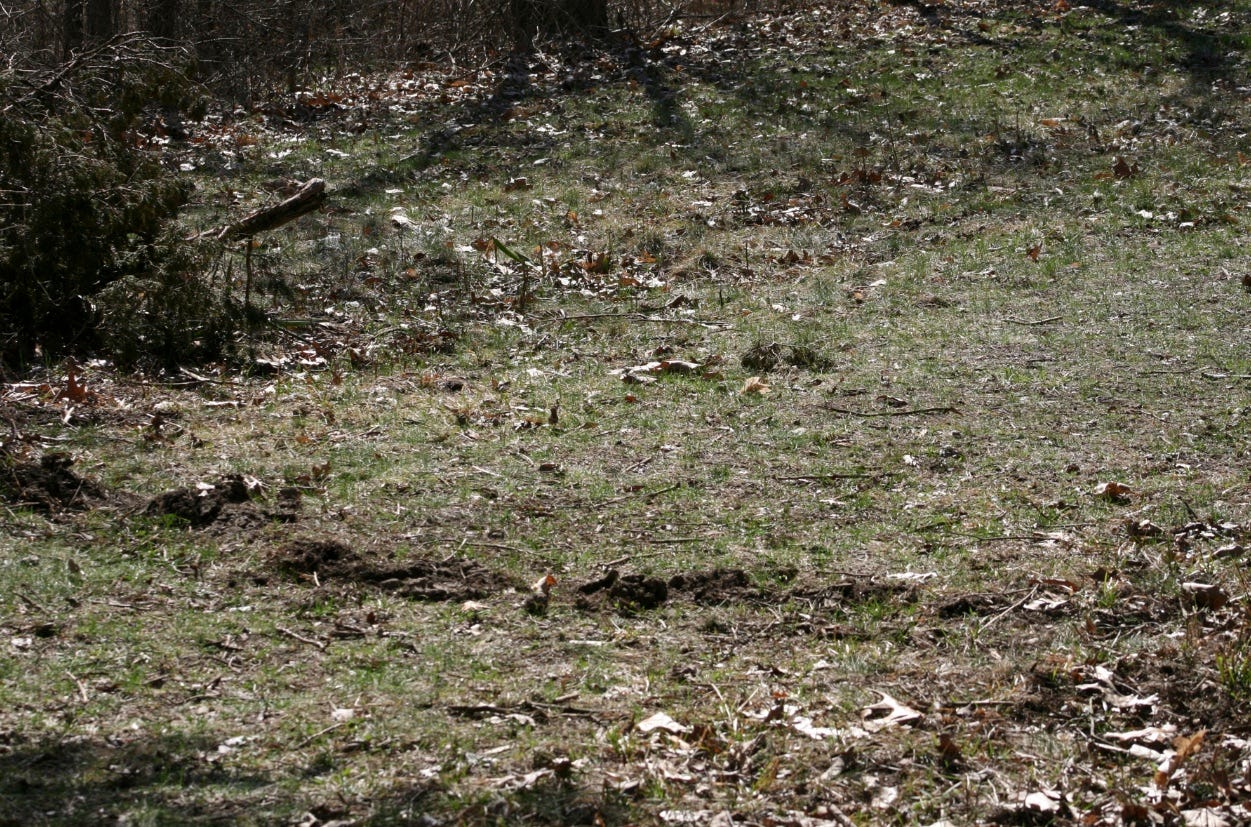
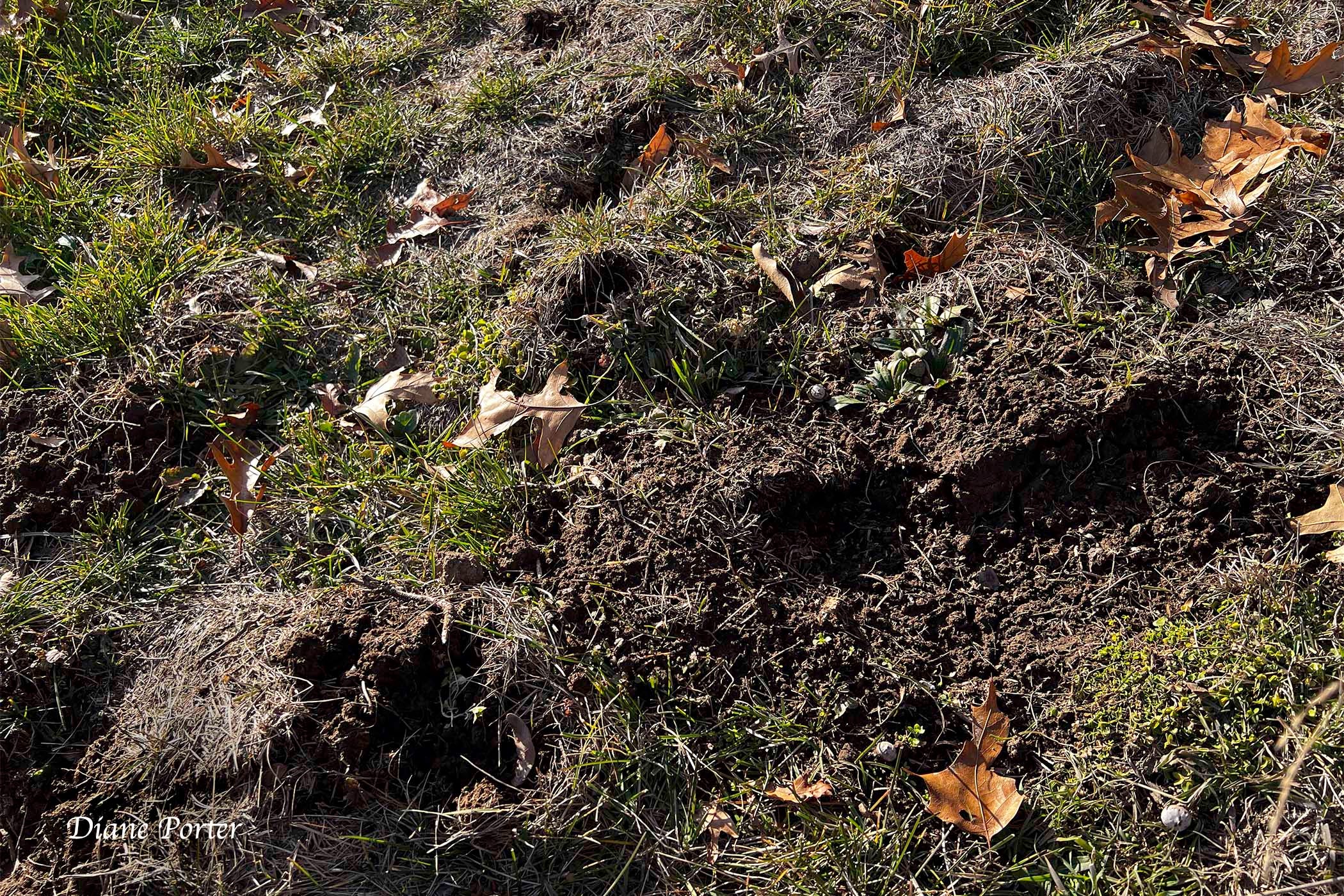
Traveling tunnels ~ On the mowed path in my woods, the ground is crisscrossed by ridges where moles have tunneled. I try not to put my foot where it will crush a little creature’s home, but sometimes there’s nowhere else to step. I’m sorry when I feel my shoe cave in a tunnel’s roof.
I often see ridges like this wherever grass is kept mowed so that the ground surface is visible. These are shallow, temporary runs, where a mole catches its prey, which is mostly earthworms.
Deep chambers ~ Moles also dig deeper holes that can go three feet down, lined at the bottom with soft grass. These are more permanent runs, used as sleeping chambers and for females to rear their young. They are also pantries, stocked with paralyzed earthworms. Kind of like how we store food in the fridge.
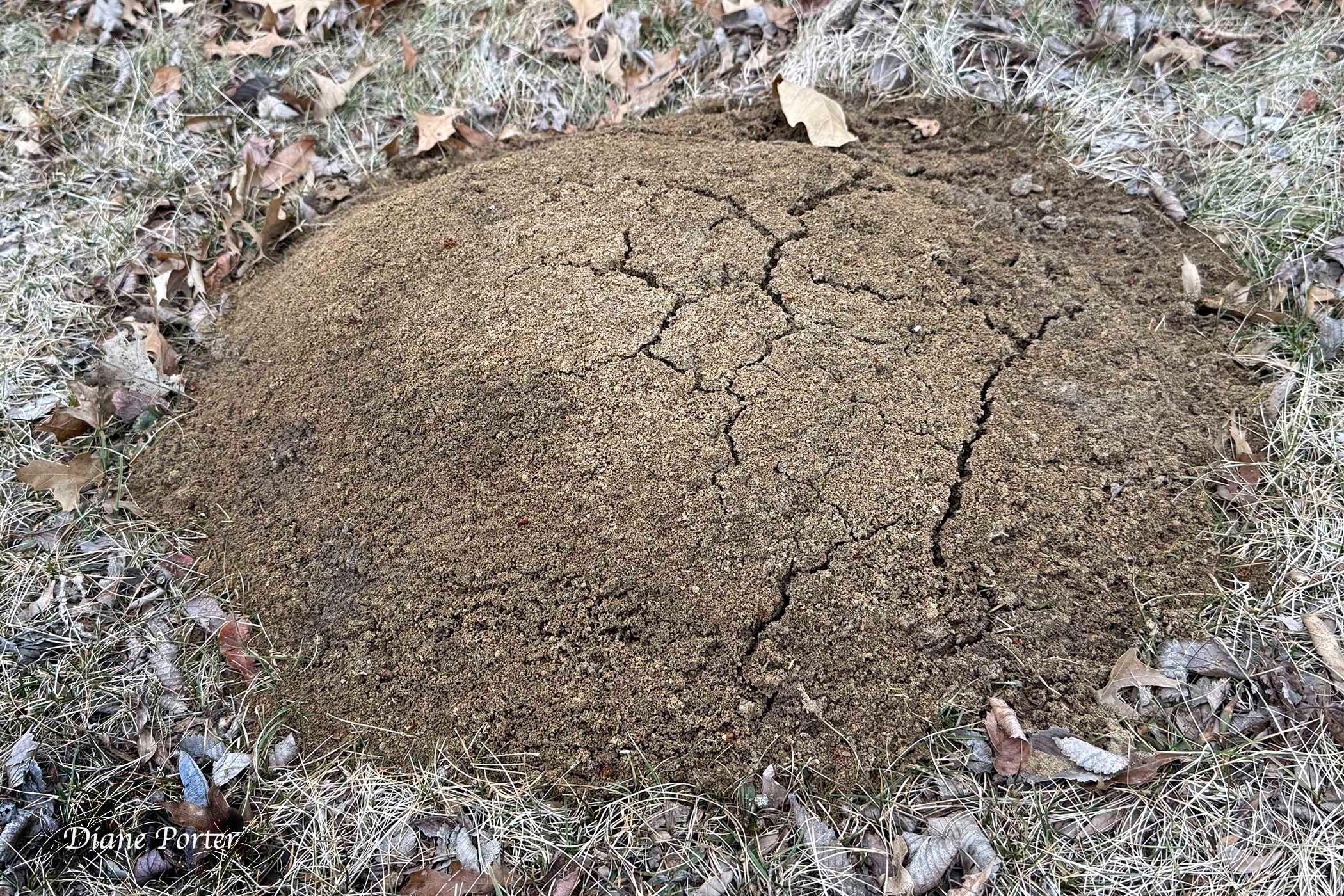
It’s easy to spot where a deeper chamber is, because it’s topped with a round, domed mound of soft soil. As a mole digs down, it pushes the dirt up to the surface, using its back feet. The mound is about 4 inches tall and usually less than a foot wide. There is no hole showing, because it is not a doorway.
Finding each other
Males and females each have their own network of tunnels. They do not live together. A male mole maintains a territory as big as two or three acres. A female’s is less than one acre.
In late winter, both males and females emit chemicals from their scent glands that signal they are ready to mate. When a male’s tunnel gets close enough to a female’s for him to detect her scent, he breaks through. They mate and then go back to their separate tunnels and lives.
When Baby Eastern Moles are a month old, they leave their mother’s home and go out to start their own tunnels. I’d love to watch the young emerge, but most likely that happens under cover of tall grass and out of sight. This is a dangerous moment in the life of a young mole, when many are taken by hawks, owls, and larger mammals.
Living with moles
Mole mounds and tunnels can cause grief to people who are trying to maintain a nice lawn. However, in a natural setting, moles are valuable citizens. They aerate the soil. Their tunnels absorb rain water and slow runoff, and their mounds provide an ideal medium for seeds to germinate.
A long view
I’m lucky to live outside of town, where no one cares if my “lawn” is in a state of churn. Often when I need a little soil for a flowerpot, I visit a mole hill and scoop up some of the soft earth.

Sometimes, looking at the field beside my house, I have a vision, a time-lapse view spanning centuries. I see a prairie in flux. I see, beneath the wildflowers, the earth is constantly renewing.
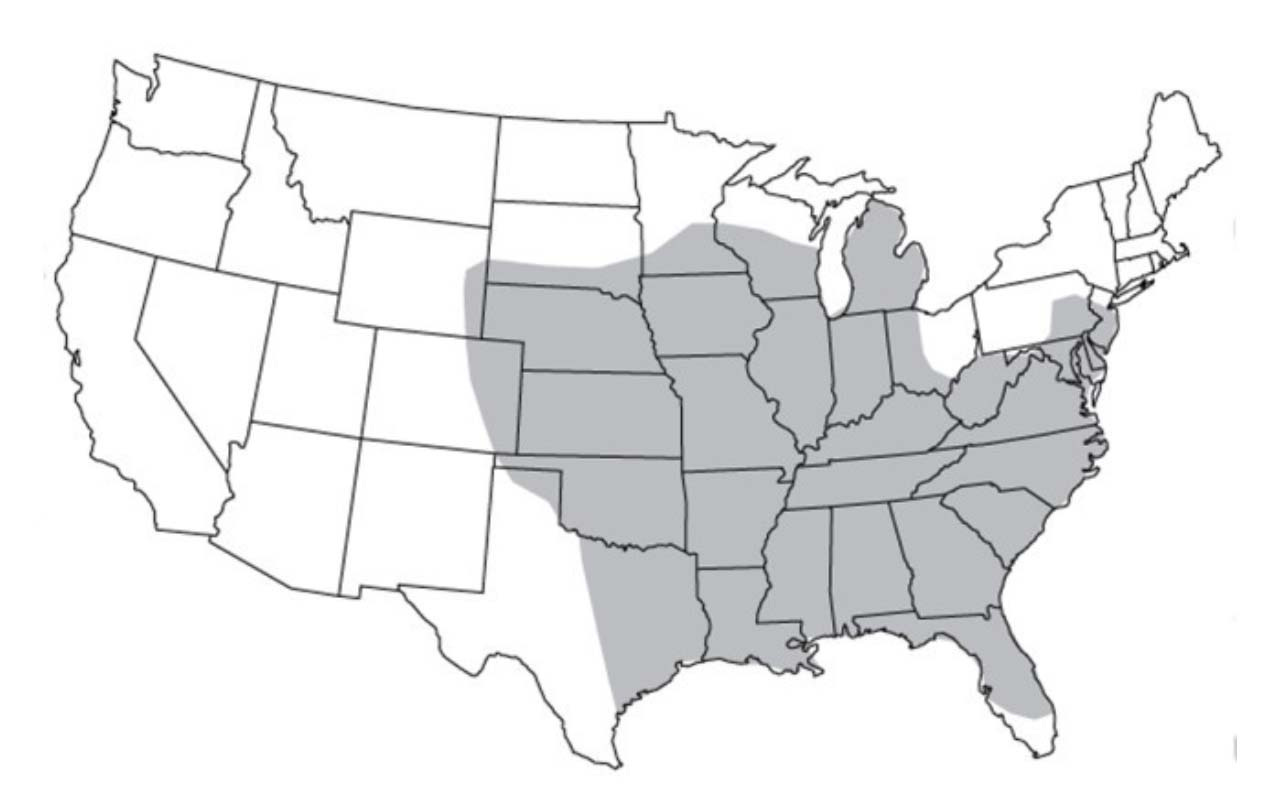
Natural range
There are several species of moles in North America. The Eastern Mole is abundant in loamy soils, such as in forests, pastures, gardens, and lawns.
Hello Diane, Stereo sniffing! This make me smile. I may have to turn up the left side tweeter! :-)
Seriously, I have been giving it some thought, and I totally get what a benefit it would be to knowing whether to dig to the right or the left for my next worm, if I were a mole. It is hard enough to imagine digging through dirt to do this, but just digging without a clear direction indicator would be madness. I like these little guys, so good to know that they are not totally blind (so to speak) in their hunt for din-din. Over here on the west coast, the habits of our moles are a little different. Though they do have both tunnels and hills. you can have dozens of hills on your property each spring. Surprisingly, you may only have 1 or 2 pairs of moles doing all this hill building activity. In more rural areas we also have Mountain Beavers. They are totally nocturnal and rarely seen. They tend to live near the edge of forests. They are a bigger rodent and one of their more endearing habits is that of gathering bouquets of things like sword ferns, salal and Oregon grape that they take down into their undergrown dens. Because the bouquets are big, they often leave them at the entrance and make several trips up and down the tunnel to take 1-2 stems at a time. I am so charmed by their perfect bouquets whenever I come across one.
Our “lawn “is in a “constant state of churn” too, Diane. But our digging team is an armadillo family. They are very industrious, and if we lived in town, our lawn would be a scandal. But we value them for the same reasons you value your moles. Besides, they were here first.😊