

Dark-eyed Juncos are a cold-weather pleasure in Iowa. They breed in Canada, but when the young are raised, they go south for the winter. Apparently, Iowa is south enough for some of them. Our frozen landscape is their second home.
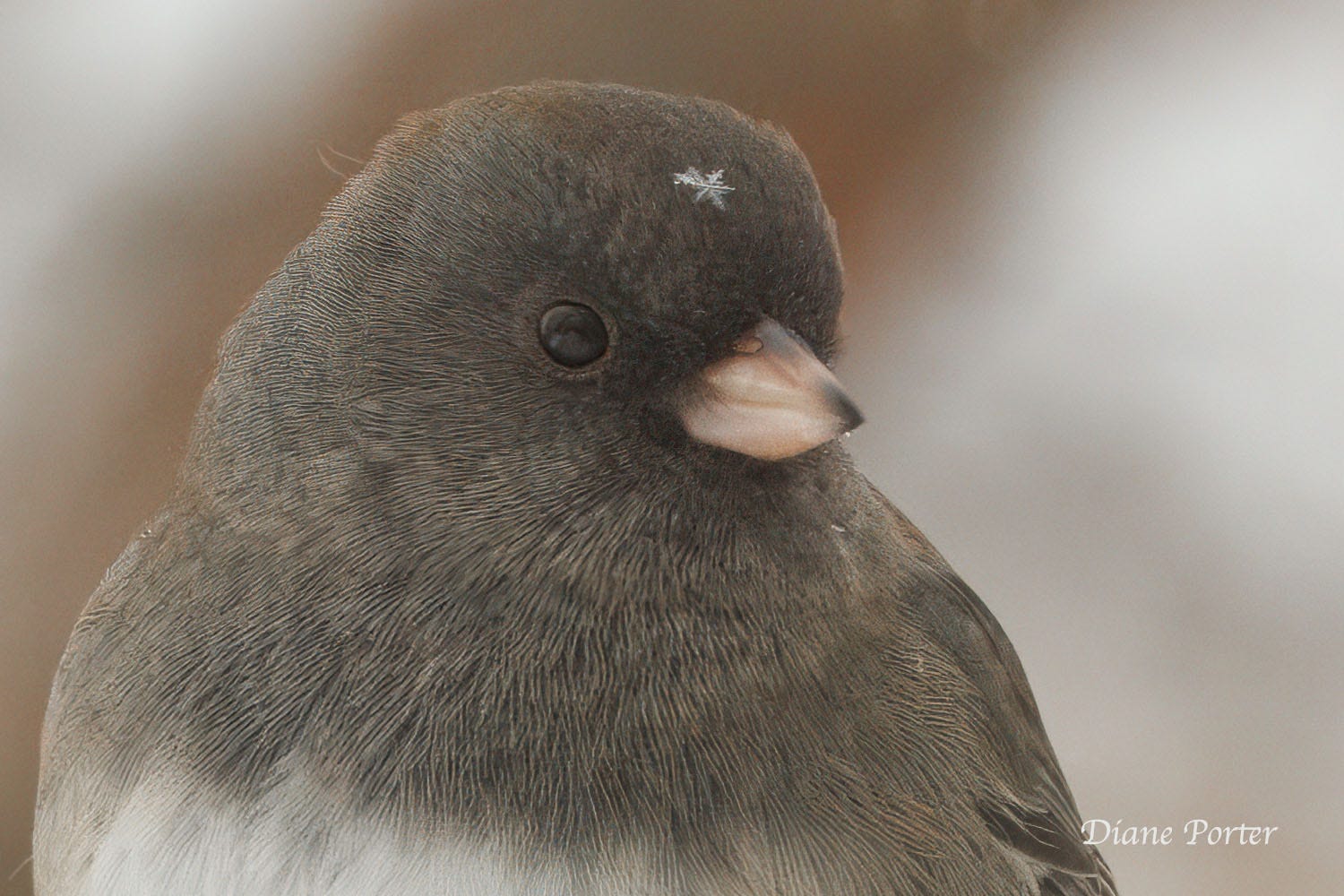
I was standing at the edge of the woods, watching a light snow fall. A Dark-eyed Junco landed on a twig near me and displayed a crystalline star.
After a few moments, it flew to the ground, where it joined its flock. The birds jumped backwards again and again, scratching snow away on the woodland floor and rattling leaves with each leap. Something there was good to eat among the exposed leaves.
Never walk when you can jump
Dark-eyed Juncos don’t so much walk as bound, with their feet together. As if jumping for joy.
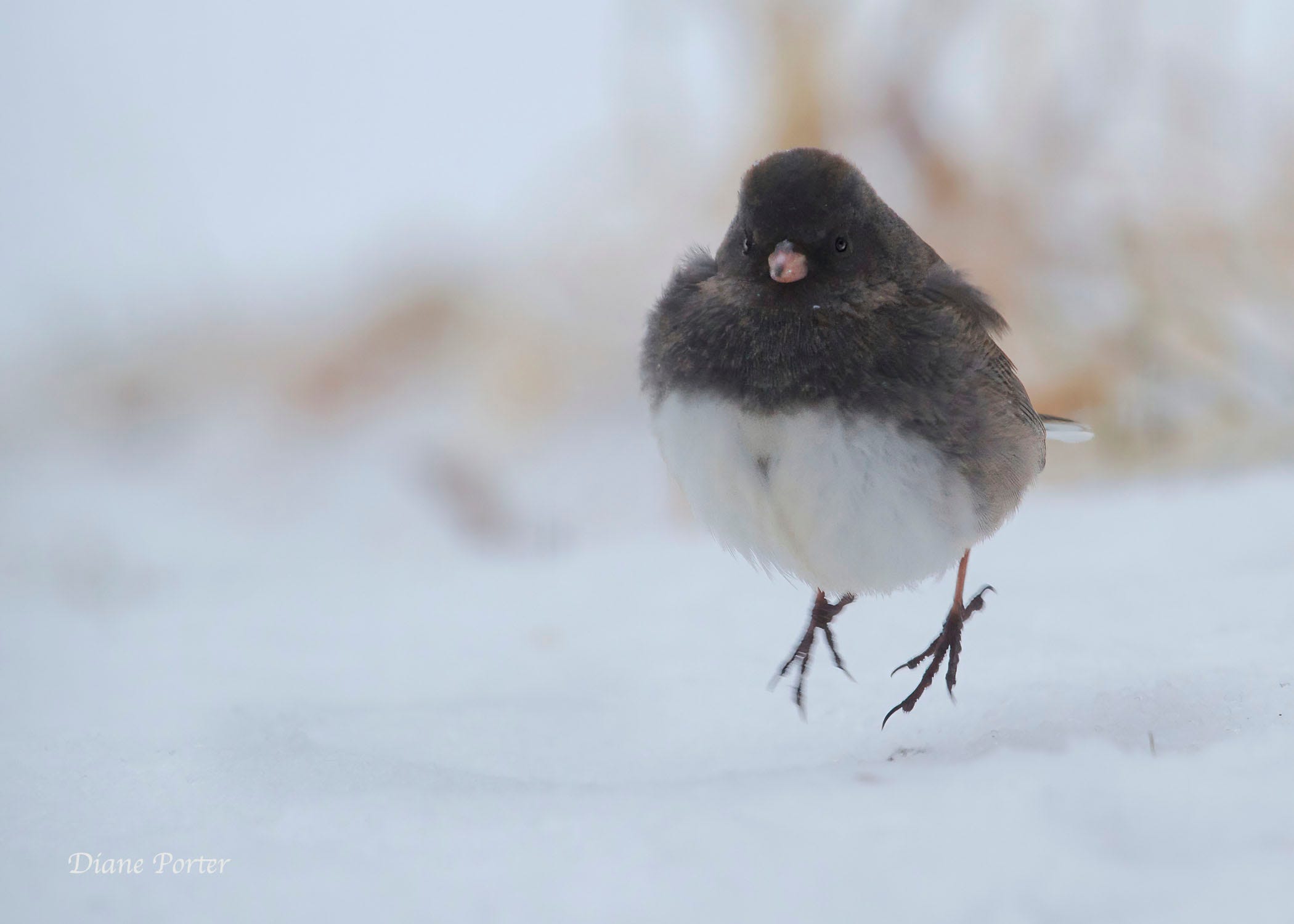
I seldom see a junco by itself. If I see one, the rest of its flock is nearby.
At home in the snow
Juncos are the early birds. Well before the sun rises, and even if the temperature is zero, they’re scratching for breakfast. Sometimes it’s still so dark that I can barely make out whether it’s birds that I’m seeing or only fallen leaves ruffled by the wind.
Often their songs reveal their presence. They sing a juicy trill, interrupted by an occasional tisk-tisk.
Singer: Junco hyemalis / Recordist: Diane Porter
As winter tilts toward spring, the juncos sing more and more, until the morning air is full of their music. I love to hear them at that time, even though it means they will soon leave us and fly away north to nest.
They’re friendly
Juncos seem to trust me. They come close and search around my feet for the morning’s gift of sunflower seed hearts. Their friendliness washes over me.
Sometimes they perch nearby and look me straight in the face. I wonder what they’re thinking.
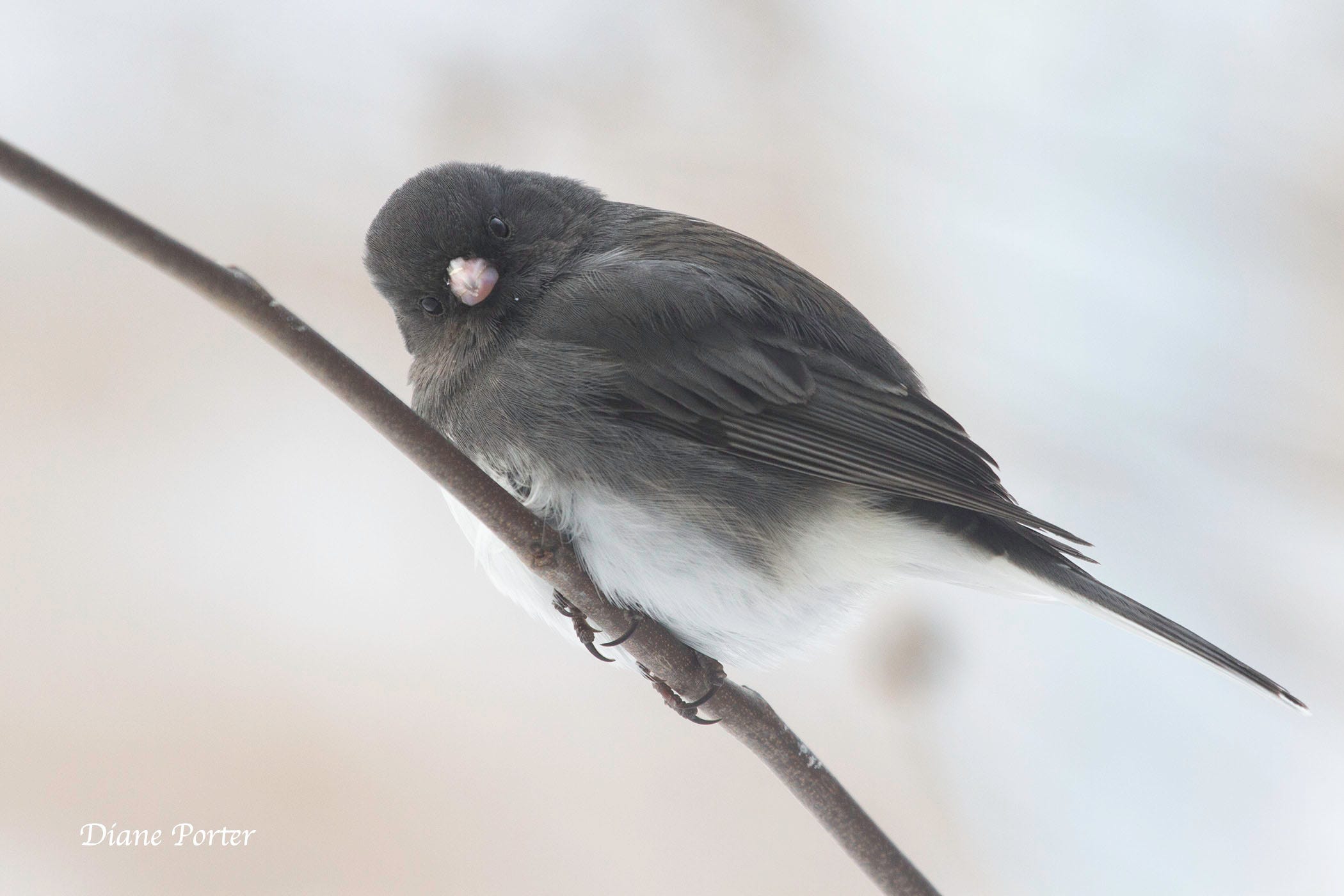
Dark-eyed Juncos live throughout North America. Their looks vary somewhat from one part of the continent to another. These variations are known as subspecies.
The subspecies in Iowa is the “Slate-colored” Dark-eyed Junco. Adult males have a hooded look, dark gray to black on their backs. Females are lighter gray above. Both have snow-white bellies. Their pale beaks tend to a tender pink.


All Dark-eyed Juncos have white outer tail feathers. These white feathers are inconspicuous while the birds are foraging on the ground. But when a junco flies, it spreads its tail, revealing the white edges. This is a signal to the rest of the flock that it is time to get the heck out of there. They all fly off together like a gust of leaves.
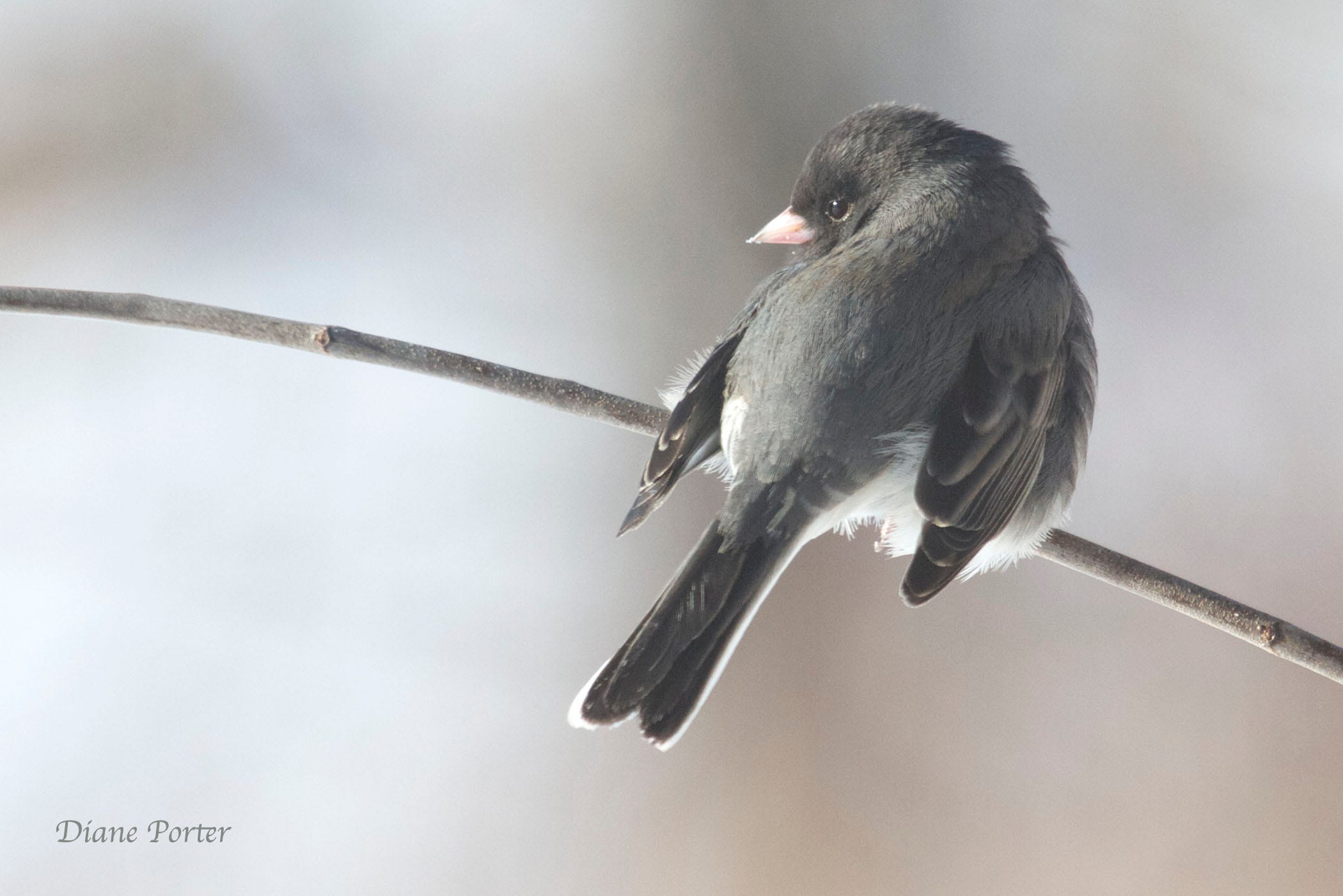
Even in the coldest Iowa winter, the Dark-eyed Junco always warms my heart.
The map below, from the Cornell Lab of Ornithology, shows the range of Dark-eyed Juncos, including all subspecies.
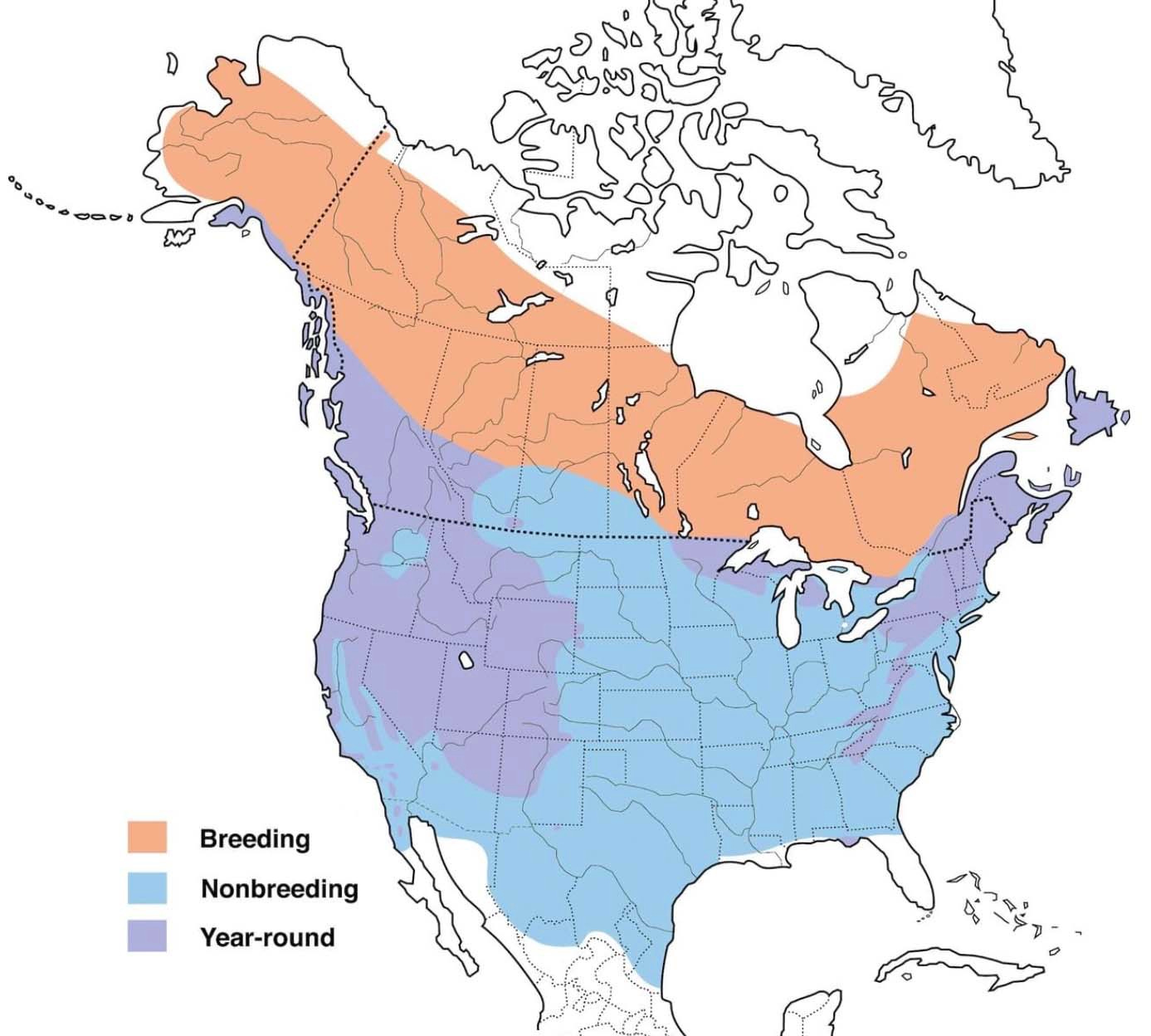
The purple areas are where Dark-eyed Juncos live all year around. Orange is the breeding range, and juncos are found there only during spring and summer. In fall they leave their nesting regions and winter in blue areas. I like to think of this bird taking a trip south to my back yard for the winter.
Dark-eyed Juncos were my first ornithological love! I began studying them almost immediately after being hired at Powdermill in 1983, and I studied them for almost 15 years, focusing mostly on esoteric subjects like molt patterns and wing shape variations in relation to migration ecology. In spring, fall, and winter I studied the migratory "Slate-colored" juncos, which is the so-called nominate subspecies, Junco hyemalis hyemalis. I scored extent of molt and wing shape variables for thousands of juncos over a period of ten years, and with help from colleagues was able to publish results in a series of peer-reviewed papers. But, I also studied the local breeding juncos, which could be ascribed to the southern Appalachian subspecies, J. h. carolinensis. These juncos live at higher elevations mostly above 1800 ft. near Powdermill, and in the winter many of them "migrate" downslope to winter in the milder valleys--a distance of mere single digit miles, but a world of difference in terms of prevailing weather and, to some degree, availability of bird feeders! This subspecies is my favorite--it is larger than the nominate subspecies, has a medium slate bluish gray coloration that is continuous across the upper parts (i.e., no difference in color between the head and back), and its bill is bluish horn color as opposed to pink. They are really striking! You mention in your piece about the hopping gait and scratching behavior of juncos in winter, but did you know that in the breeding season they change their gait to a walking one? You will not see a junco on the ground hopping in summer--they stride deliberately one foot after the other, picking insects from the low vegetation and leaf litter. If you watch Song Sparrows closely, you will see that they, too, shift to a walking gait when they are nesting! I've never seen this discussed or studied in the literature, but it has always fascinated me! Anyway, I loved your "Jumping for Joy" piece about my first bird love! In case you're wondering, my second and current bird love is the Louisiana Waterthrush, which I have now studied for more than 25 years! Don't ask me to choose between them--I adore them both!
Your pics of the Juncos are just terrific! Can't say which charms me the most. The one wearing his lovely little snowflake or the little guy doing the 1-2-3 Jump! I give him a 10 for his perfect pointed toes! And thanks for the very happy audio!