

Putting together this timeline of our planet brought it home to me that life is old. Life has been here five-sixths as long as Earth itself. But plants and animals big enough to see are new, having emerged fairly recently.
The chart spans 4.54 billion years. At full resolution of 4540 pixels, each pixel of width represents one million years.
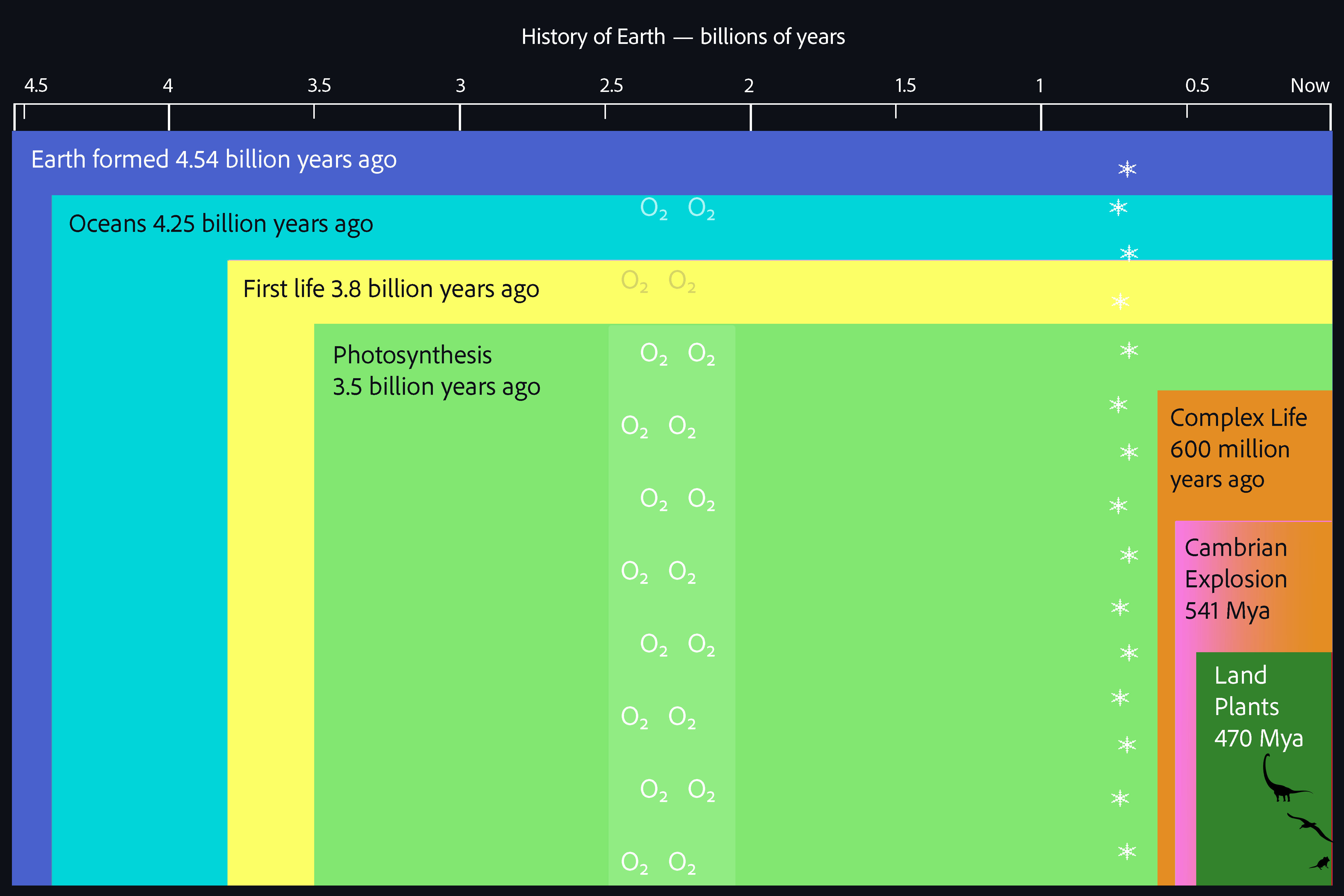
Planet and oceans
Earth formed from swirls of galactic dust 4.54 billion years ago. The oceans assembled not long after.
First life
In the oceans, the first living things appeared by about 3.8 billion years ago. If you could time-travel back to look at that life, you would need to take along a microscope, because there was nothing alive that was big enough to see with the naked eye.
In the oceans lived minute organisms, single cells that lacked a nucleus. They were prokaryotes (“pro-carry-oats”). Neither plant nor animal, they were the ancestors of everything alive today.
For your time travel, you’d also need to take along your personal air supply, because there was no oxygen in the atmosphere.
Photosynthesis
Around 3.5 billion years ago, some prokaryotes made the brilliant discovery that they could capture sunlight through photosynthesis. After that, light energy powered their metabolism.
Another billion years passed before some of the prokaryotes cracked the difficult problem of how to use ordinary water in photosynthesis. Once they did so, oxygen became a byproduct.
And that changed the world.
Great Oxidation Event
With the seas full of single-celled, oxygen-producing life, oxygen eventually started accumulating. On the chart, a band of O₂ marks 300–400 million years during which oxygen built up in the atmosphere — the Great Oxidation Event.
It was a slow catastrophe for much of life on Earth. Many organisms could not tolerate oxygen. However, some found a way to live with it, and even to use oxygen as fuel. Those survived. Thrived. Expanded massively.
The Boring Billion
Geobiologists sometimes call the years between about 1.8 and 0.8 billion years ago the Boring Billion, when the Earth and life changed very slowly.
Great things were happening, though. Some single-celled organisms developed cell nuclei and discovered sexual reproduction. The first multicellular organisms appeared, some big enough to be visible to the naked eye. Some were threadlike filaments. Others were thin mats growing across rocks at the bottom of shallow seas, or tiny blobs of only a few dozen cells.
Still no animals.
No shells or skeletons.
No plants on land.
Earth remained a world of very tiny organisms in a mostly warm ocean.
Snowball Earth
Around 720–635 million years ago, the climate flipped. The world felt a big chill that came and went for about 85–90 million years. At times ice choked the oceans, perhaps covering the entire planet. Life retreated, but it was not entirely wiped out.
On the chart, a line of snowflakes marks the time of Snowball Earth.
Complex life
After the ice melted at last, life seemed to pause for tens of millions of years, as if catching its breath.
And then, about 600 million years ago, bigger, flat, soft-bodied life forms appeared. They were something new: they did not make their own food by photosynthesis. Instead, they ate other organisms.
They were the first animals.
Cambrian explosion
Starting about 541 million years ago, animals began diversifying fast. In the Cambrian explosion, we find fossils of shells, spines, and exoskeletons.
During a brief time of 20–25 million years, life was exuberantly creative. Over half of the major animal body plans (phyla) alive today first appear in the fossil record during the Cambrian explosion. One phylum is Chordata—animals with a spinal cord — which includes us. Another is Arthropoda — the arthropods — which includes insects.
No major animal phyla are known to have originated after that time. On the chart, the Cambrian explosion appears as a narrow magenta band.
Moving onto land
All major plant lineages began in the sea. Plants, which evolved from photosynthetic algae, adapted to life on land starting about 470 million years ago. Their descendants became mosses, ferns, conifers, and flowering plants.
Animals
Like plants, the animal phyla also originated in the ocean. Animals followed plants onto the land, pioneered by arthropods, including millipedes, insects, scorpions and spiders. Later came other land animals, including snails. After a few hundred more million years, animals with spinal cords clambered onto the land.
No animal phylum has ever originated on land.
Recent times
Dinosaurs appeared close to the right edge of the chart. They reigned for less than 200 million years and disappeared abruptly 66 million years ago, after the Chicxulub asteroid impact. When the dinosaurs went extinct, small mammals found an ecological opportunity and expanded immensely. Birds had already taken flight. They survived the extinction and flourished.
If you click the chart and expand it to see it at full resolution, you may notice a thin red line at the right edge near the bottom. That marks the appearance of the earliest Homo, or human, species, about 3 million years ago.
Our own species, Homo sapiens has been around only 300,000 years and cannot be shown on the chart, as the line would be less than half a pixel wide.
Back in another lifetime, not meriting even 1/100 of a pixel, when I taught 6th grade I used a lot of hands-on tools to teach the timeline of Earth's history. It was always a mind-blowing event for the children. It's still a mind-blowing understanding for me. We have such an inflated sense of self. It comforts me to know what a blip we are in time, and in space. It scares some folks.
This is so fascinating. Thanks for summarizing this in such a succinct and easy to understand way!!