

Down the grassy slope from my house, in June a great tangle of wild roses suddenly blooms with hundreds of flowers. They billow in every tint from deep raspberry through pale pink to nearly white.
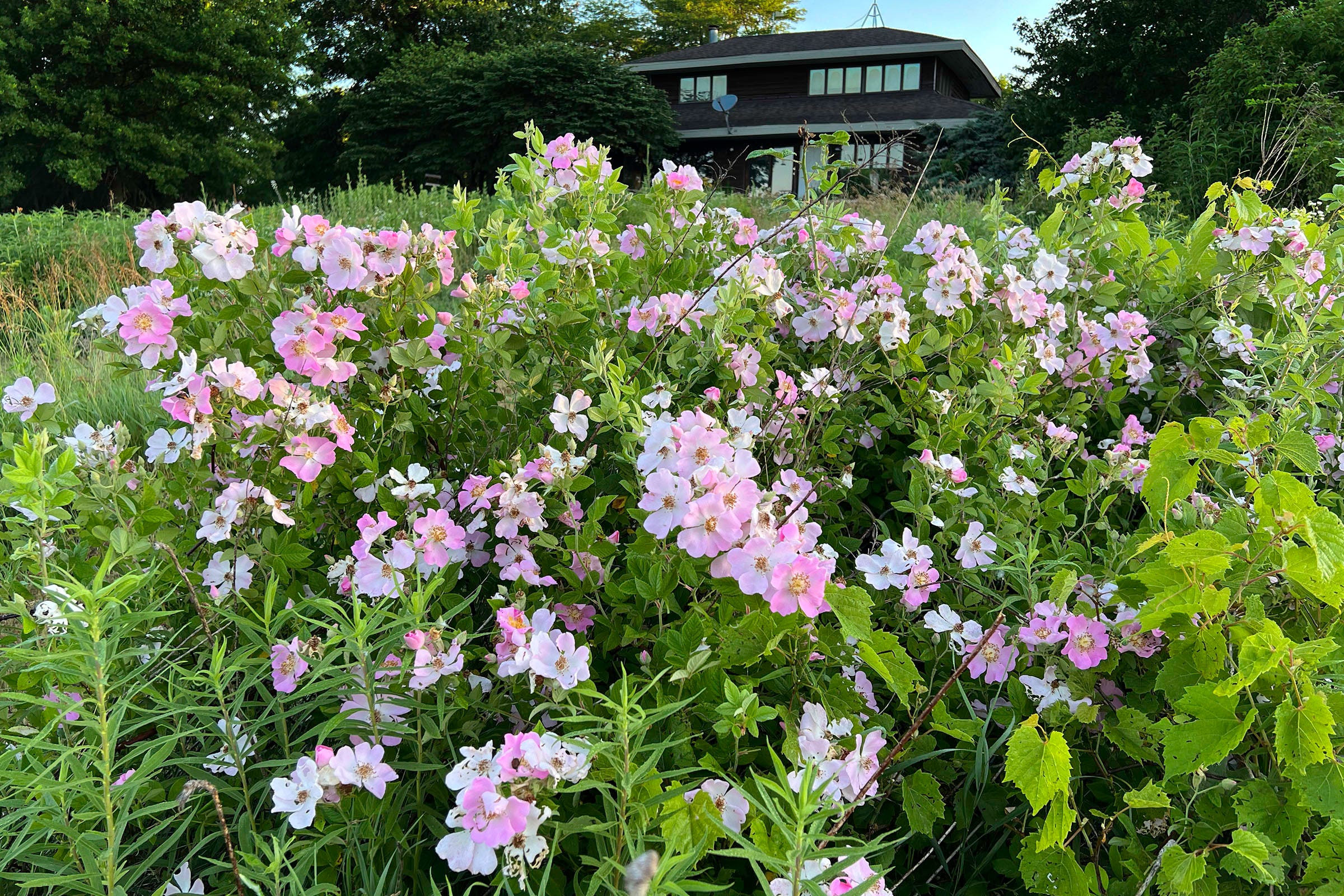
It is the Climbing Rose, one of Iowa’s several wild roses. According to botanists, it is considered uncommon in Iowa. I’m rather pleased to find that it grows on my land.
On a sunny morning, bumblebees are wallowing joyously in the blossoms. They buzz.
Hear the buzz
Slow motion movie reveals what a bee is doing
It’s pollen that the bees are after. The whole point of blossoms, if you’re a rose, is to entice a bee to carry pollen from one flower to another and pollinate it.
The pay
The bees are willing workers, because pollen is food. Concentrated protein. Exactly what female bees need for the larvae growing in the nest. Female bees gather pollen, munch some for themselves, and take most of it back to the nest.
In the process, they spread pollen around. And that works great for the flowers.
Male bees
There are far fewer males (drones), because colonies produce few of them until late summer. They do not collect pollen for the colony. They live primarily on nectar, though they may eat a bit of pollen now and then. They may even pollinate the occasional flower. But mainly all they have to do is live long enough to mate with a virgin queen in late summer or fall.
The difference
This species of rose is different from almost all other roses in the world. Nearly all other roses are bisexual: every plant both produces pollen (male job) and makes rose hips (female job). But with the Climbing Rose, each plant is either male or female — not both.
Male Climbing Rose plants have flowers that make pollen but never make rose hips. Female Climbing Rose plants have flowers that make rose hips but produce little or no functional pollen.
The trick
To entice bees to carry pollen from a male plant to a female plant, the Climbing Rose uses trickery.


The female’s anthers look real, but they produce no pollen. A bee is fooled and lands on the flower. Finding no pollen reward, she flies away. However, the moment of contact was all it took to pollinate the flower.
In the center of the female flower is the pistil, whose sticky tip (the stigma) receives the pollen. At the lower end of the pistil is the ovary, where the future seeds develop.
The male flower also appears to have a pistil, but there is no ovary and nothing to pollinate. It’s a fake. This makes it hard to tell the two sexes apart, no doubt for bees as well as for gardeners.


Under the microscope, I see a subtle difference. The female stigma looks more solid. On the male it looks looser. The difference is not visible to the naked eye, at least not to mine. I doubt the bees spot it, either.
My Climbing Roses
I enjoy collecting seeds of native plants and growing them on, and I’ve searched the Climbing Roses near my house for rose hips. Over the years, the vines produced thousands of flowers, but never a single hip.
When I learned that individual Climbing Roses plants are either male or female, I realized that my patch was male.
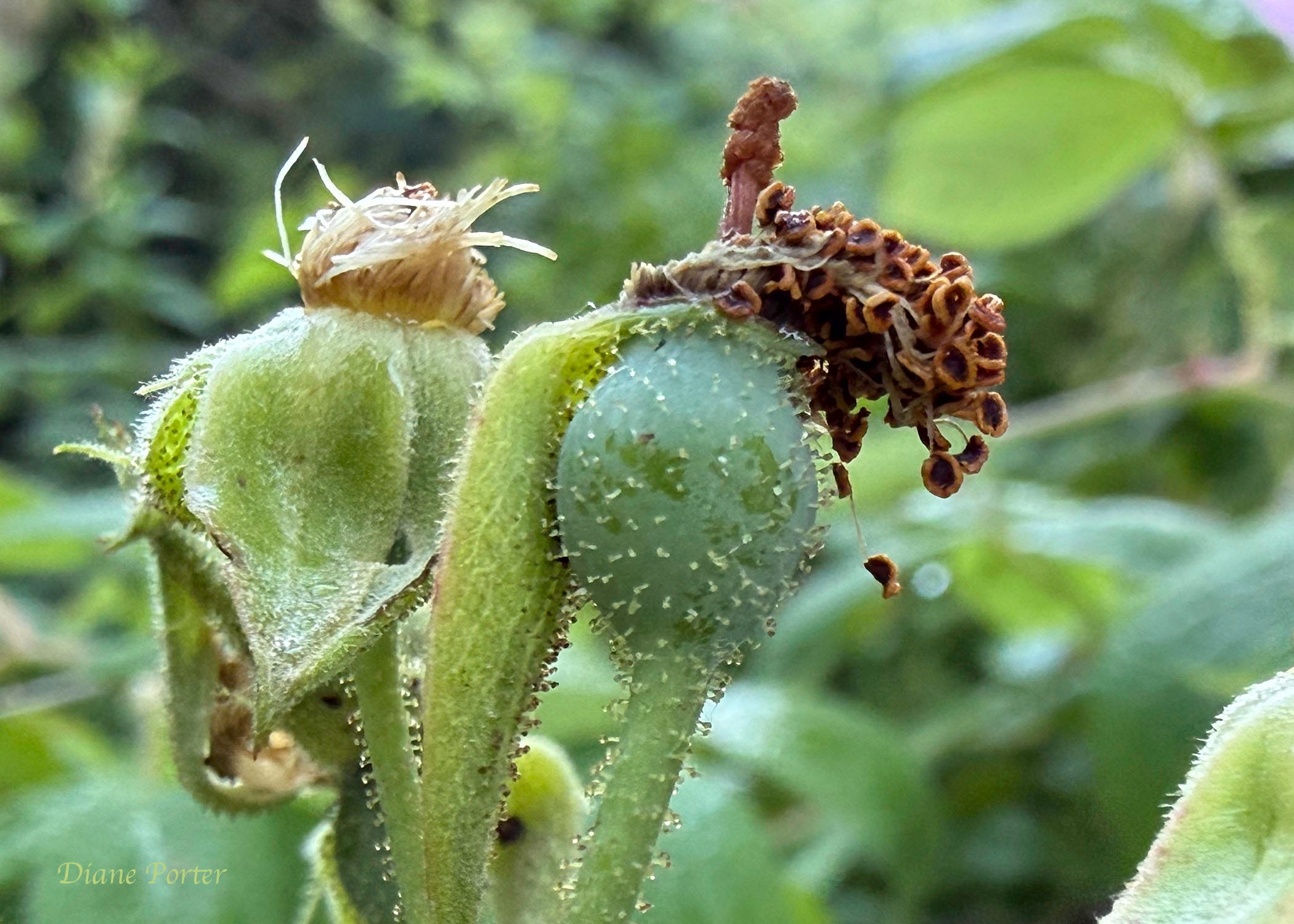
Three years ago a Climbing Rose volunteered at the corner of my porch. This year it is blooming for the first time. Now, as the petals fall, the bases of the flowers are beginning to swell. The rose shows all the signs of being a female.
Today the rose hips are small green spheres. By fall they should be bright red and full of seeds.
Thanks for this educational posting! Very interesting read this morning.
Isn't it lovely that we now have the ability to know so much about the circle of insect life? No longer do we have an excuse to say, "It's just some bug." 😘