

Perfect little pits dot the dry soil next to the house. The biggest are the size of silver dollars, and the smallest the size of dimes. I’ve been seeing them the last few summers. They are under the eaves, where rain does not fall. Ants often mill about erratically.
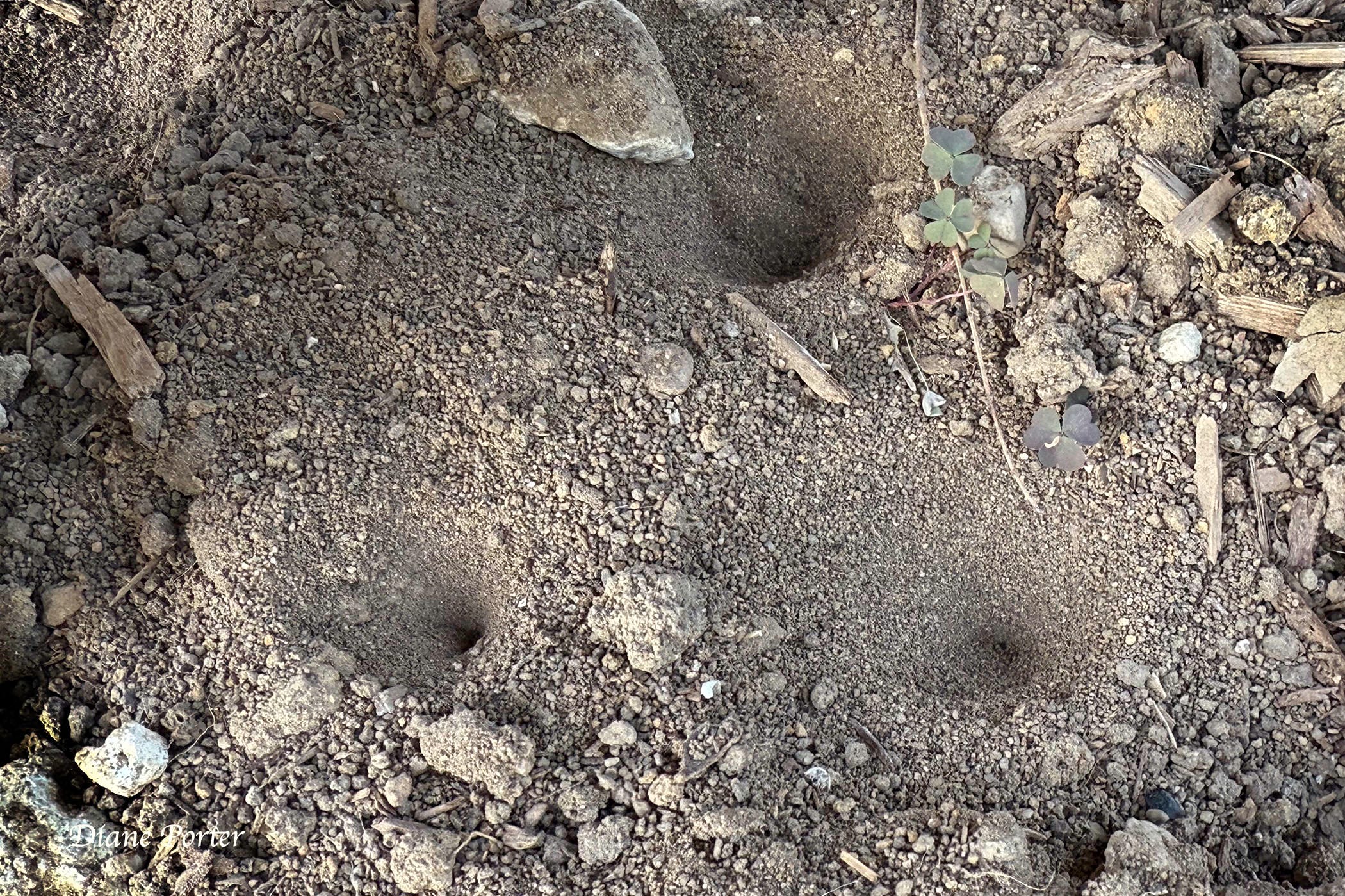
In the bottom of each pit, barely under the surface, a wild animal waits. A tiny predator. An antlion.
Now and then an ant stumbles over the edge of one of the pits and slides willy-nilly to the bottom. It tries to run back up, but the sand caves in under its scrambling feet.
A pair of pincers rises out of the pit and grabs. The ant is caught.
Video by Diane Porter
The antlion moves fast but almost clumsily, as if doesn’t exactly know the ant’s position. It grabs several times before getting a sure hold.
I can’t see the whole antlion. Only its head and pincers poke out of the sand
I used to handle antlions when I was a child, in California. They never bit me. I decided to try it now.
With my fingers, I scooped under the pit and came up with small handful of soft, sandy earth. I let it sift away, until only the antlion remained. It scooted backward on my palm, trying to back down between my fingers.
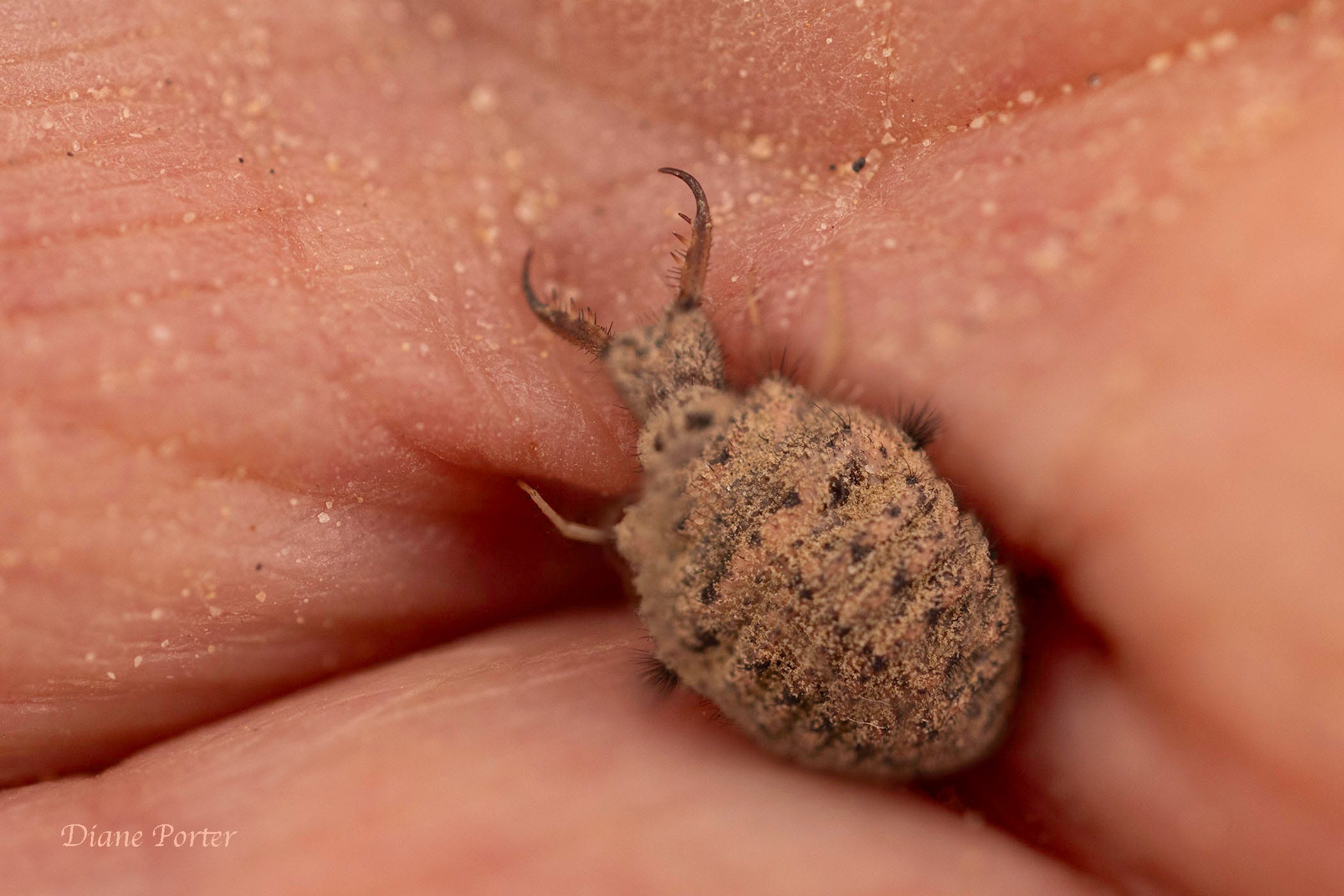
It tickled softly. The creature did not bite me, though its pincers must be horrible to an ant.
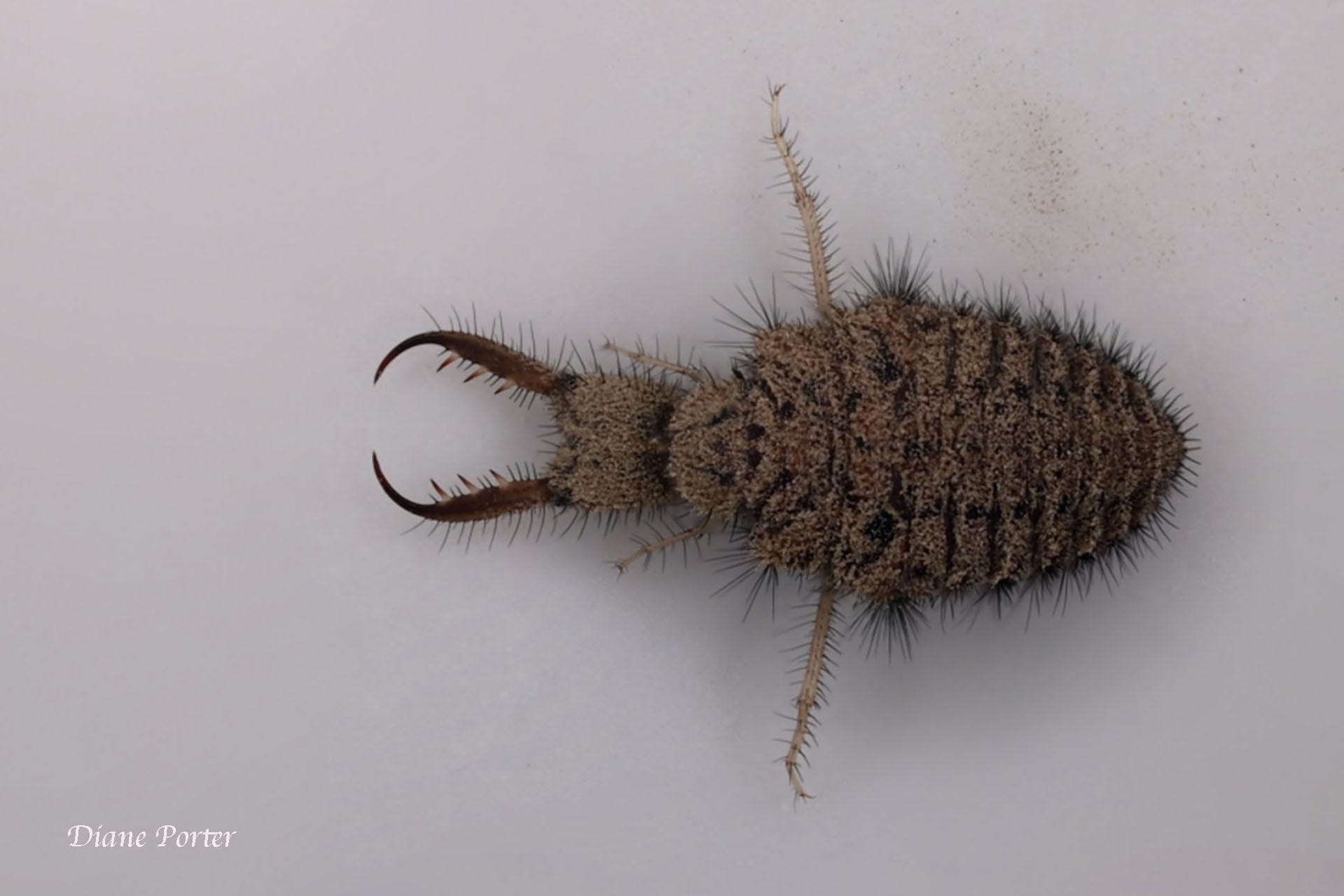
Here’s a picture of antlion through my microscope. It is spiny everywhere, but it feels soft to human skin. Look at those amazing pincers!
Gotcha
A slow-motion video shows the antlion grabbing at the ant blindly. But of course! The eyes are tiny and detect only light and dark, not images. On the photo above you can perhaps make out the left eye, which appears as a black dot. The pincers open and shut repeatedly, until as if by accident they get a secure grip. Then they remain clamped, and the antlion feasts.
Video by Diane Porter
When the ant is drained dry, sometimes the antlion tosses the husk up out of the pit. This seems an impossible feat of strength, which I have read about but have never witnessed. I have, however, found a few ant carcasses just outside the pits.
The antlion has four life stages: egg, larva, cocoon, adult. All the photos above are of the larval, “lion of ants” stage. The adult looks like a delicate damselfly.
I have never seen an adult. I’m looking forward to meeting one next spring.
Oh, Diane, your photos and video are a treasure! I see these pits every day in the dry area near the bird feeders and knew they were antlion lairs. But this is my first sight of these tiny predators, so fierce in their small worlds. Thank you for this delightful introduction!
Predator and prey…how to love both? I love chipmunks and I love owls…l had a dog who killed snakes…I loved the dog and I loved the snakes. It’s a condrum!